Automatic Edge Detection for Faster and More Accurate Hardness Testing
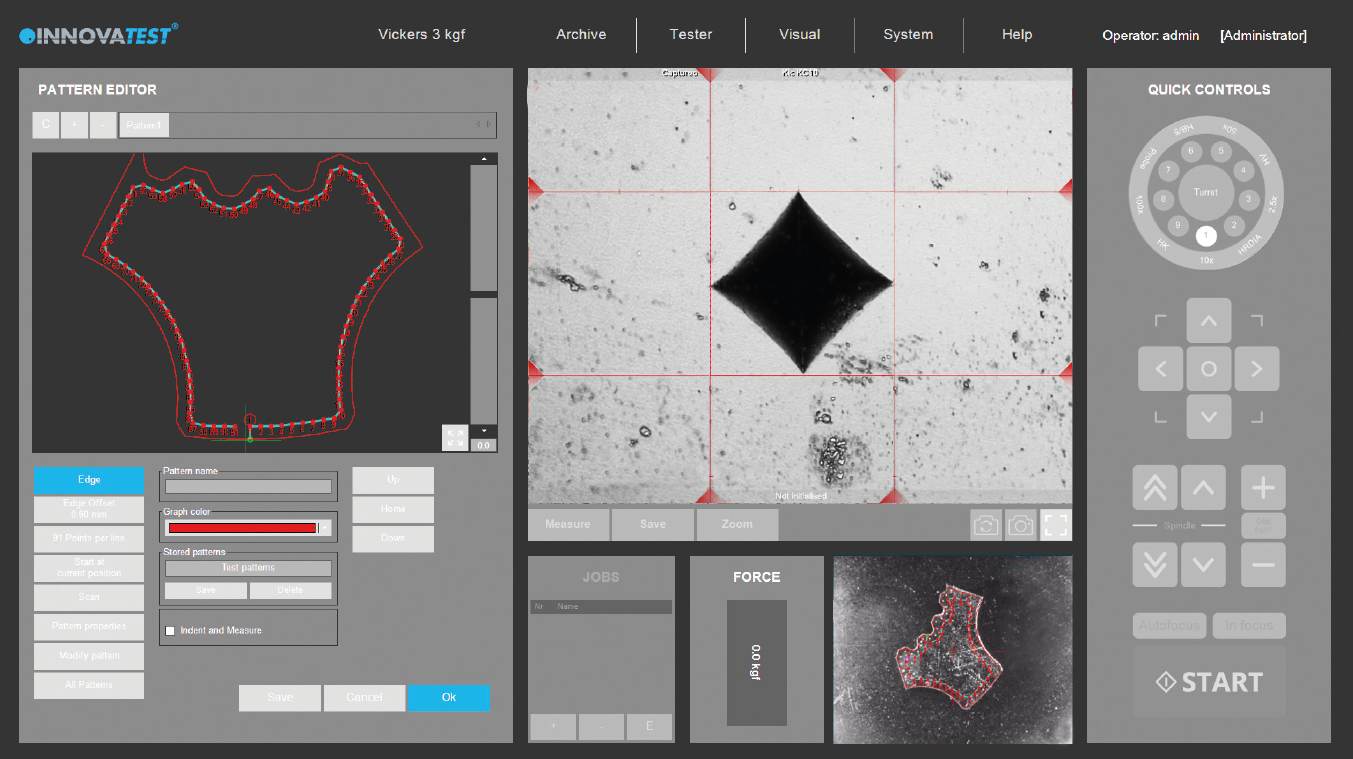
The IMPRESSIONS™ Automatic Edge Detection module simplifies and accelerates pattern testing, case hardening depth (CHD) analysis, and multi-point hardness testing by automatically identifying the exact edge of your sample.
Using advanced contrast recognition technology, the software detects sample boundaries instantly—either fully automatically or with a single mouse click—allowing operators to define precise starting positions for Rockwell, Brinell, and Vickers hardness testing applications.
This improves setup speed, reduces operator dependency, and ensures highly repeatable results.
Intelligent Edge Recognition for Precise Test Positioning
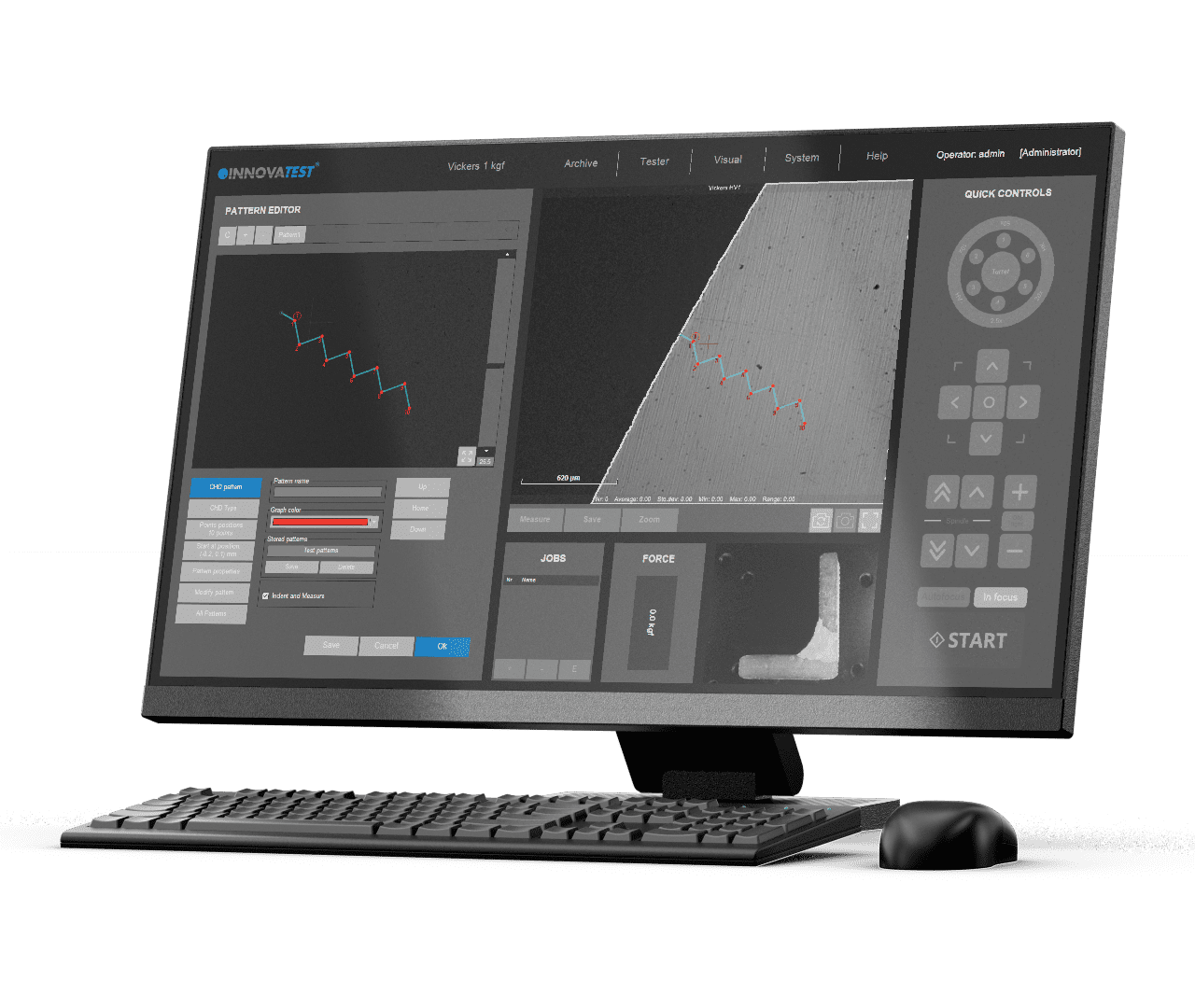
Accurate edge detection is critical when hardness measurements must be taken at specific distances from a surface, weld line, or treatment boundary.
The system automatically analyzes contrast differences between the sample and background to determine the exact sample edge.
This ensures consistent and reliable test point placement across every sample.
Optimized for CHD and Case Depth Analysis
Automatic Edge Detection is especially valuable for Case Hardening Depth (CHD) testing, where accurate positioning relative to the surface is essential.
This creates a faster and more reliable workflow for heat treatment verification and surface hardness analysis.
Seamless Integration with Pattern Testing
The module works directly with the IMPRESSIONS™ Test Pattern Editor, making automated multi-point testing even more efficient.
This is ideal for laboratories and production environments where speed and repeatability are critical.
Applications of Automatic Edge Detection
Automatic Edge Detection supports a wide range of hardness testing applications where precise positioning is required:
This makes the module a key tool for both routine quality control and advanced material analysis.
Automatic vs Manual Edge Positioning
Traditional manual edge positioning requires operators to visually estimate sample boundaries and manually place test points, which can be slow and inconsistent.
Automatic Edge Detection offers a major advantage:
Manual Edge Positioning Limitations
IMPRESSIONS™ Automatic Edge Detection Advantages
By eliminating manual positioning, the system improves both testing speed and measurement reliability.
Improved Workflow for Modern Hardness Testing
Automatic Edge Detection reduces setup time, improves precision, and supports more advanced automated testing workflows.
Combined with pattern testing, contour scanning, and hardness mapping, it creates a highly efficient and intelligent hardness testing environment—designed for modern laboratories, production facilities, and research applications.
The result is faster testing, stronger repeatability, and greater confidence in every hardness measurement.